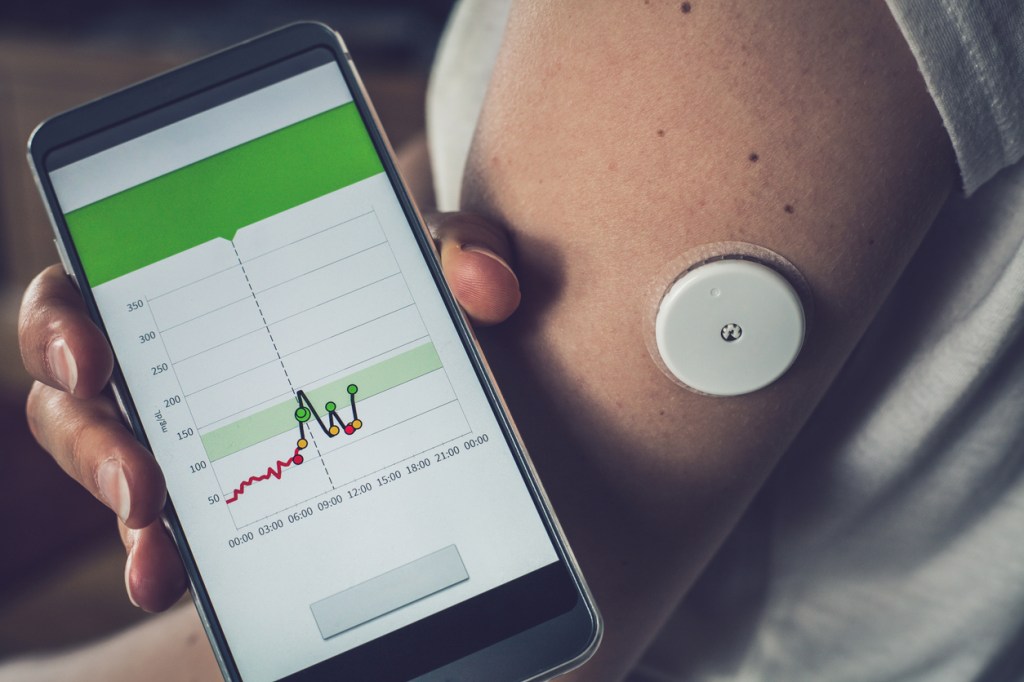
If you are a diabetic, trying to manage your diabetes doesn’t have to be hard.
Finger prick monitoring shows accurate in-the-moment insulin levels but continuous glucose monitors (CGM) allow you to see trends and observe the impacts of your diet and activities on your levels. Choosing the right continuous glucose monitor (CGM) can be overwhelming, though. Have you found the right one for you? Let’s go over the options so you can reach an informed decision.
Many of the basic features of CGMs are the same. Let’s review what those are before looking at what’s unique about the most popular options on the market. They all come with a subcutaneous sensor and transmitter which connects wirelessly to a receiver. Receivers have trend graphs, direction and rate-of-change arrows, as well as the ability to log extra data. Sensors are inserted with a device and may be re-usable. Data is sent to the receiver whenever it’s in range.
Here are the top 4 continuous glucose monitoring systems that you might want to consider if you are a diabetic:
1. Senseonics Eversense CGM
The Senseonics Eversense CGM has the least medical waste, as the transmitter can be changed without removing the sensor, which is guaranteed for 90 days. The sensor needs to be changed at a physician’s office, though and has 24 hours before it is warmed up. It also needs calibration twice daily. There are great functions that keep you informed such as vibrate or audio real-time alerts for out of range, high, low, rate of change, or predictive low. It is also not impacted by acetaminophen.
2. Freestyle Libre 14-hour CGM
The Freestyle Libre 14-hour CGM doesn’t need daily calibration, is the most inexpensive, and has the shortest warm-up of one hour. Unfortunately, it doesn’t have real-time high/low alerts and without that calibration, is the most inaccurate in low glucose range. The sensor can store up to 8 hours of data and the reader can store notes and events but they must be entered at the time. The low profile transmitter has an adhesive that may not last the 14 days of the sensor life. It can also be impacted by vitamin C and aspirin.
3. Medtronic Guardian3 – 670G or Guardian Connect CGM
The Medtronic Guardian3 – 670G or Guardian Connect CGM has a reusable sensor with a life of 7 days. It has a single button insertion with a 2-hour warm-up time but can cause skin issues with complicated multiple tapes. There are customizable alerts for different times and days with vibrate and audio limited only by your phone’s options. There are real-time alerts for high, low, rate of change, or predictive low/high. It needs calibration every twelve hours to continue data generation. Guardian Connect only works with Apple apps but has real-time sharable data as well as an app that generates reports. It’s also impacted by acetaminophen.
4. Dexcom G6 CGM
The Dexcom G6 CGM does not need calibration but it is available to improve accuracy. The sensor has a single push button insertion and is good for 10 days. It has customizable alerts including an “always on” feature for if your phone is on silent. It has a high level of waste from the costly sensors and transmitters, and reusing the sensor can be difficult.
For more information on different healthcare topics, follow the Avidity Medical Design Blog. To take a healthcare course, visit Avidity Medical Design Academy.

 The Avidity Medical Design Blog