The Truth about Advisors

The word “advisor” encompasses many things when dealing with a University. With on-campus Universities, the advisor is most likely a professor/instructor at the school. With online universities, it works a little differently.

Student working with her advisor while taking her online class.

Student working with advisor online in the healthcare classroom.

Each university has its own unique procedures in what their advisors are responsible for. Many times an initial admissions advisor, sometimes known as an admissions representative, will guide you through the application process and your initial financial aid process. It is their responsibility to direct you through the initial application process, retaining any necessary transcripts, work history or other experience that could count towards the degree you choose. This includes helping you make an informed decision about the degree options that would be best suited to your needs.

How to Work with Your Advisor When Taking Online Classes

Once you have chosen your area of study and have been accepted, a new academic advisor is assigned to you, knowledgeable in your specific field. He will counsel you on your first steps, if you are new to the online process. This includes your first class, specifically designed to acclimate you to the online class process. Depending on whether you are full or part time, your advisor will guide you through the classes that will best fit your schedule. A financial aid advisor will be assigned for financial questions.

Academic advisors are trained to know the courses necessary for the degree that you are pursuing.  They will also answer any questions unique to the career or career path that you are seeking. For instance, if the degree you seek is psychology, you will have the further options of going into counseling, research, medical, etc. Having an idea ahead of time will help you tailor your degree. Fear not, though, you have the prerogative to change your path at any time and your advisor will guide you through the steps. The same goes with certificates; whether you choose medical transcription, medical billing, or any other related field, your advisor is there to guide you.

An advisor is concerned with your educational outcome and the career you will be stepping into. An advisor is not responsible for problems you are having with your instructor. That is between you and your instructor. An advisor can help you find alternative classes, however, if you feel the class is not working out for you. But it is your responsibility to know the add/drop dates so that you are not charged. Your advisor will most likely not contact you to see if you like the class or how you feel you are doing.

Chances are your advisor has also taken classes at the university you are attending. They will be familiar with the basic guidelines. But keep in mind that every instructor is different and your advisor may not be acquainted with your particular one. Generally your syllabus and class guidelines will give you all of the information you will need to get through your class.

Students are often reassigned advisors, depending on the circumstances of the university and you will be notified who your new advisor will be. Fear not, the new advisor will be up-to-date on your particular course of action. Most importantly, though, you are the one responsible for keeping up with your classes and your progress. Keep track of your classes, GPA, and future course of action so that, no matter who your advisor is, you know where you are.

For more information, please feel free to contact us.

girls sitting on the floor while using their laptops

Completing Homework in the Online Classroom

One of the biggest differences between online and on-campus classroom dynamic is person-to-person contact. While we are not face-to-face with the instructor, oftentimes we can actually have more contact with the instructor. We are less likely to respond in a classroom setting, whereas online, it is a requirement and the instructor schedules in time to grade exams and essays, as well as read each student’s post, including their responses. So the instructor actually gets a better view into a student’s individual personality and a good feel for the overall comprehension within the class group. This can be immeasurable in knowing how to complete homework assignments in the online environment

Student completing homework online.

Student completing homework online.

Online courses run on a weekly schedule, whether it is 8 or 16 weeks. For example, class will begin on a Monday and end on Sunday. The first day of class will begin with an introduction from the students and instructor. This is the time to let the instructor and other students in the class know who you are geographically, what your major is, how long you’ve been in school, etc. It also gives you a chance to show a little side of your personality. It’s not a bio, just an introduction. If you are unsure when you first start, there will probably be one or two students who are familiar enough to start the general posts. Just read through those and fill in your own information in your own way. This is an excellent way to gain a good rapport with your instructor as well as the other students. He/she will understand that you are engaged.

Most online universities run the schedule to the left (or the right) of the screen when you are “in” your class. Instructors will post or dictate what the week’s lesson is, including whatever readings, websites, research, etc. that needs to be done in order to fulfill the week’s requirement. You will have until Wednesday or Thursday to respond. Additionally, you will need to respond to at least two other students who have posted. The instructor expects these to be well thought out answers, and your response will be included in your grade, so consider them part of the weekly assessment.

Depending on the university, you can look ahead and get a feel for the work coming your way. Most syllabi will cover most of it. Don’t rely on the syllabus alone. Instructors generally add vital information at the beginning of the week through their own post.

In most classes there will be some sort of assessment at the end of each week, be it an online exam, amount of online homework completed, or an essay. Sometimes, in addition to posts, there are other activities that involve other students, who will be depending on you for part of their grade, whether it is helping with research or in submitting the final project.

Most times the instructor will not overwhelm you with material, but sometimes, particularly in upper level courses, there is a lot of material to cover and comprehend for overall comprehension. Some classes, such as mathematics, have online homework that gives you instant feedback. It is also included in your final grade. This is especially useful for students struggling to understand a concept, but it can also throw you behind if you get caught up in one particular section. Email your instructor, another student in your class or the university’s student services if you have any problems.

Falling behind in one class will also jeopardize any other classes you are in so it’s a good idea to prepare yourself mentally. Accept ahead of time that this can happen and prepare physically to thwart any hills coming your way. Mostly this means just being present, in class, in activities and in reading the material assigned.

Commit yourself openly for the first couple weeks until you can get a feel for completing expectations. Measure your homework against any other classes you have as well as your own personal schedule. Keep in mind, of course, that the class itself will become more demanding as the course progresses. Most students will find that they fare better in their own major classes. Consider balancing one in your major and one outside requirement so that you don’t have two classes that bog you down.

Again, instructors aren’t usually trying to overwhelm you, but sometimes there is a lot of reading and research involved. Making sure you have enough time to complete the requirements and comprehend the lessons for the week will most assuredly help you pass the class.

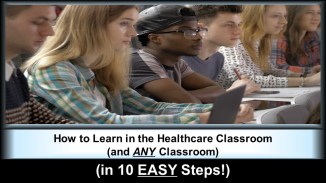
How to Learn in the Healthcare Classroom. Course offered By Avidity Medical Design Academy.

For more information on how to learn in the online classroom, visit Avidity Medical Design Academy. Enroll in the course entitled, “How to Learn in the Healthcare Classroom (and ANY Classroom) (in 10 EASY Steps!)

Appropriate Email Etiquette in the Online Classroom

An online classroom provides a unique way to interact with your instructor and peers. You may feel comfortable enough with them to joke around, and you may even think you can address your professor more as a peer than an authority figure. However, the written word is often misunderstood, and you still are the student, not another professor.  You can run the risk of misrepresenting yourself through email and on discussion boards if you aren’t careful. Here are some tips for email etiquette in the online classroom:

Email Etiquette in the Online Classroom - From The Avidity Medical Design Blog.

Students checking email in the online classroom.

  1. Always address your professor with respectConsider your professor to be your boss, and address her with the same level of respect. NEVER address your professor by her first name unless you have received explicit permission to do so (heads up, you won’t). Use appropriate language, i.e. no slang or swear words. Your written word is the only way your instructor knows you. Make a good impression.
  2. Don’t sound angryWhen you’re upset about a grade or comment your professor made, it’s natural to feel angry and defensive. Use email to your advantage though. Your professor can’t see your emotions here, so this is a chance to demonstrate your maturity and respect even in the midst of your internal anger. Instead of making accusations, ask for clarification as to why you earned the grade or comment in question. Approaching a conflict respectfully and with a congenial tone will go a long way. Remember, your words are the only way your professor knows you. Just like number 1, make a good impression through email.
  3. Never EVER make a threatSometimes we forget that emails are permanent. If you have a true problem with a professor, seek help from another source like your academic advisor. Your professor will take your words seriously, which can result in serious consequences for you. Don’t even joke about a threat. Just. Dont.
  4. Avoid jokes among peers: Online discussion boards are the online equivalent to a classroom discussion. The main difference is inside a classroom, everyone is participating at the same time and can understand your attitude and tone when you make a particular statement. Your peers can feed off of your instructor to determine whether or not you are being appropriate. Abide by the blanket rule to not tell jokes and you’ll be fine.
  5. Respect your professor’s timeJust because you’re up and writing a paper at 11:00 on a Tuesday night does not mean your professor is also awake and ready to answer her emails. Sending her a second message at 2 am will not make her answer your question any sooner. In fact, you may get the opposite result. Abide by the virtual office hours she has set up, and allow an appropriate amount of time to pass before re-sending her your question. A good rule of thumb is up to 24 hours on a weekday and 48 hours on a weekend, unless your professor has stated otherwise. Remember, as an online professor she is serving hundreds of students. In order to keep an appropriate work/life balance, she will have to set boundaries. Observe and respect these boundaries.

How to Learn in the Healthcare Classroom. Online course by Avidity Medical Design Academy.

Taking online classes can be a rewarding experience, especially for students who can’t otherwise fit college classes into their schedule. Visit Avidity Medical Design Academy to enroll in the online course entitled, “How to Learn in the Healthcare Classroom (and ANY Classroom) (in 10 EASY Steps!)“.

man using a laptop

3 Ways to Study for Online Classes

With online courses, students have the flexibility of taking their class whenever they want, wherever they want. But with so much flexibility, how do students stay on top of everything?

Student taking an online course. From the Avidity Medical Design Blog.Because online classes don’t consist of a physical classroom and in-person teacher, studying for them may require even more discipline and organization than a regular class would. Students, rather than the teacher, will have to be the ones reminding themselves of when an assignment is due or when a midterm will be.

To help you stay on top of your online classes, here are three study tips that will keep you productive.

1. Create a study schedule for yourself

Because online classes are more flexible, creating a study schedule will help students stay on track. One way to do this is to look at your syllabus and put any due dates onto your calendar. After that, schedule days to study for that exam. What’s more, blocking out time for studying can help you schedule time for work  and family as well.

2. Log into your class daily

One way to stay on top of your online classes is to make sure you’re always updated on it. One way to do this is to log into your online class on a daily basis and see if there are any new messages from the teacher or if any assignments have been rescheduled. Knowing that you’re always checking in will make your online class less overwhelming.

3. Communicate with your teacher on a regular basis, especially if you are struggling

It can be intimidating to ask a teacher for help sometimes, but getting direct help from them is always better than getting stressed out from not knowing what to do. This being said, it’s always a good idea to check in regularly with a teacher to see if you’re on the right track.

how to learn in the healthcare classroom - online course offered by Avidity Medical Design Academy

For more information on the healthcare, follow the Avidity Medical Design Blog. To learn more about our online courses, visit Avidity Medical Design Academy. Enroll in the course entitled, “How to Learn in the Healthcare Classroom (and ANY Classroom) (in 10 EASY Steps!)” offered by Avidity Medical Design Academy. To purchase scented candles and soaps inspired by healthcare, visit Avidity Medical SCENTations.

How to Minimize Distractions During Your Study Time When Taking Courses Online

Taking online courses sounds like a great idea at first glance. There’s no need to go to a physical location, you can study and complete your work when it’s convenient for you, and the courses are by and large less expensive than traditional courses are. The problem many students realize is that study time becomes even more important when there’s no class time.

That’s why it’s important to minimize all possible distractions so you can get the most out of your study time.how to minimize distractions during your study time

How to Minimize Distractions During Your Study Time

In order to avoid distractions you need to have answers to all of the basic questions before you sit down to work. Who, What, When, Where, How (we know why you’re studying, so you get that answer for free).

Who: Are you studying alone, or with someone else? Some students work best in solitude, while others work well with someone to keep them on task.

What: What are you studying? Pick a given thing to study in a session and study that. Maybe it’s a review of chapters 1-3, or just a discussion of the last lesson, but you need to know what you’re studying in order to stay focused.

When: Different times of day come with different distractions. Late night studying is ideal for some students because it means there’s quiet and roommates or children are asleep. Early mornings might be better, particularly if there are fewer demands on your attention. Once you’ve selected a time make sure you stick to it as best as possible, and inform people who might need to get hold of you that you’re not to be interrupted during this time if it isn’t an emergency.

Where: Your location is a prime consideration when it comes to distractions. Studying in a familiar place like your bedroom might sound like a good idea but are you surrounded by too many distractions? Your TV with recorded episodes of your favorite show, friends and family stopping by to chat, and worst of all your bed constantly tempting you with a nap. Often it’s a good idea to pick a location where you have nothing else to focus on, such as the library. If leaving home isn’t an option then picking a spot like the basement or the kitchen where there are fewer distractions is a smart idea.

How: Different people learn in different ways, and it’s important to know how you learn best before you start studying. If you’re the kind of student who can just crack open a book and read that’s great, but if that approach is going to bore you then you’re going to fade quickly and your attention is going to wander. Do you need a video that shows you examples of what you’re studying to focus? Do you need silence or loud music to concentrate? Do you need to take breaks every 20 minutes or so, or are you the sort of student who if you lose your momentum will never get it back? You need to know what works best for you before you get set up.

Tips For Distraction Minimization

If you have answers to the above questions then you have the broad strokes of what you need to do to avoid distractions while you study. There are some specific things that can help if you find your attention wandering though.

– Turn Off Your Communicators: Studying is hard enough without people trying to get hold of you. As such you should close any chat or social media programs you have going that aren’t necessary, and you should turn off notifications on your phone. Leave text or the ringer on, but ignore the rest until you’re done.

Shut Your Doors: An open door is an invitation to poke one’s head in and see what’s going on. Whether the doors are real (like your bedroom door) or metaphorical (your computer’s connection to the Internet) keep them closed until you’re done.

Study in Small Doses: It’s a lot easier to study for half an hour or forty minutes a night for a week than it is to study for two hours a night for two days before a test. Your attention is less likely to wander if you just need to take a bite than if you try to eat the whole horse at once.

If you need more tips for making the most of your study time then contact us today!

how to learn in the healthcare classroom - online course offered by Avidity Medical Design Academy

For more information on the healthcare, follow the Avidity Medical Design Blog. To learn more about our online courses, visit Avidity Medical Design Academy. Enroll in the course entitled, “How to Learn in the Healthcare Classroom (and ANY Classroom) (in 10 EASY Steps!)” offered by Avidity Medical Design Academy. To purchase scented candles and soaps inspired by healthcare, visit Avidity Medical SCENTations.

What’s On The Horizon: 3 Important Trends In E-Learning

The Internet has ushered in an era of prosperity that is unmatched in modern human history. There has never been a time when the common man has been endowed with so much power to change the world through hard work and imagination.

The Internet has fundamentally changed the way we do things. This is especially true in the field of education. The traditional brick and mortar classrooms are slowing becoming extinct as digital structures take its place.

This transformation is still in its embryonic stage but is rapidly becoming the norm. More and more people are ready for changes in the way they learn and acquire knowledge.

There are lasting trends that are emerging as fundamental truths in the e-learning arena for the foreseeable future.

e-learning developments on the horizon

Online Learning Is Becoming More Social

We all learned as grade school students that humans are social creatures that thrive on social interaction.

We want to learn from each other’s experiences and gain perspective through other people’s points of view. This is the essence of learning in its most basic form. The fact that this natural function of human behavior has migrated to the digital world isn’t surprising.

What is surprising is that educators are finally catching on to this fact. E-learning courses that allow students to discover knowledge and insights and share it with their contemporaries have more successful students.

Fostering enhanced collaboration between educator and student is a trend that will continue to evolve.

Learning Isn’t Linear and Never Has Been

Conventional wisdom tells us the A+B=C and is so just because this is the way that it has always been taught. Rote learning techniques for thousands of years has been used as an efficient tool to educate millions of people around the world with great success.

While this is a testament to the enduring spirit of man to streamline the transmission of knowledge, the truth is learning has never been linear. Throughout human history knowledge has been gained and re-discovered in a non-linear fashion. This pattern holds true today in our hyper-connected world.

E-learners today spend time jumping from website to website looking for keywords, scanning articles and not even finishing a paragraph. In fact the average attention span of the average Internet user in 2014 was around 8 seconds!

E-learning courses that are data rich and easy digestible are becoming the norm in today e-learning environments. Incorporating content that is short and interesting is imperative to keeping students actively engaged in the course material.

Visuals Are On The Rise

Infographics, charts, photos and videos are quickly replacing text-based instructions. Visual presentation of information is easy to understand and is more appealing to students. Science lends credence to our predisposition towards visual information. Here are a few interesting facts about visual learning:

  • 90% of information transmitted to the brain is visual
  • Visuals are processed 60,000X faster in the brain than text
  • Our eyes can register 36,000 visual messages per hour

Click here for more information on visual learning.

The Internet, learning and how we mesh the two together will continue to shift as student learning styles and preferences change. The one constant is that the people will never stop wanting to learn.

If you have any questions about these trends or need help with incorporating some of these trends into your courses, contact Avidity Medical Design Consultants, LLC today. We look forward to hearing from you.

What’s On The Horizon: 3 Important Trends In E-Learning For 2014

The Internet has ushered in an era of prosperity that is unmatched in modern human history. There has never been a time when the common man has been endowed with so much power to change the world through hard work and imagination.

The Internet has fundamentally changed the way we do things. This is especially true in the field of education. The traditional brick and mortar classrooms are slowing becoming extinct as digital structures take its place.

This transformation is still in its embryonic stage but is rapidly becoming the norm. More and more people are ready for changes in the way they learn and acquire knowledge.

There are lasting trends that are emerging as fundamental truths in the e-learning arena for the foreseeable future.

e-learning

Online Learning Is Becoming More Social

We all learned as grade school students that humans are social creatures that thrive on social interaction.

We want to learn from each other’s experiences and gain perspective through other people’s points of view. This is the essence of learning in its most basic form. The fact that this natural function of human behavior has migrated to the digital world isn’t surprising.

What is surprising is that educators are finally catching on to this fact. E-learning courses that allow students to discover knowledge and insights and share it with their contemporaries have more successful students.

Fostering enhanced collaboration between educator and student is a trend that will continue to evolve.

Learning Isn’t Linear and Never Has Been

Conventional wisdom tells us the A+B=C and is so just because this is the way that it has always been taught. Rote learning techniques for thousands of years has been used as an efficient tool to educate millions of people around the world with great success.

While this is a testament to the enduring spirit of man to streamline the transmission of knowledge, the truth is learning has never been linear. Throughout human history knowledge has been gained and re-discovered in a non-linear fashion. This pattern holds true today in our hyper-connected world.

E-learners today spend time jumping from website to website looking for keywords, scanning articles and not even finishing a paragraph. In fact the average attention span of the average Internet user in 2014 was around 8 seconds!

E-learning courses that are data rich and easy digestible are becoming the norm in today e-learning environments. Incorporating content that is short and interesting is imperative to keeping students actively engaged in the course material.

Visuals Are On The Rise

Infographics, charts, photos and videos are quickly replacing text-based instructions. Visual presentation of information is easy to understand and is more appealing to students. Science lends credence to our predisposition towards visual information. Here are a few interesting facts about visual learning:

  • 90% of information transmitted to the brain is visual
  • Visuals are processed 60,000X faster in the brain than text
  • Our eyes can register 36,000 visual messages per hour

Click here for more information on visual learning.

The Internet, learning and how we mesh the two together will continue to shift as student learning styles and preferences change. The one constant is that the people will never stop wanting to learn.

If you have any questions about these trends or need help with incorporating some of these trends into your courses please contact us today. We look forward to hearing from you.

Fostering Virtual Community Enriches Healthcare e-Learning

Healthcare e-Learning can be a solitary and sometimes lonely undertaking. Helping students get to know one another, and form a community, can be beneficial during and after the class. Even if students work in the same building, they may not know each other. Taking a course together can be a bonding experience.

For some e-learners it can be particularly motivating to have a group of friends online to share insights and experiences. When the course is over, these relationships can help reinforce what was learned during the course.

Some students study together live, at scheduled times. Others go at their own pace, on their own schedule. Here are ways to build virtual communities, which address the needs of both types of learners.

healthcare e-learning

Virtual community can help make online learning more fun

Virtual Student Lounge — Having a space where people can gather informally, to discuss material or other topics, fosters community. Facebook groups and Google hangouts are popular options, as are online forums. If the technology is available, create a space within the e-learning portal.

Student Profiles — Invite students to create on-line profiles. Encourage them to include hobbies and interests, so students can discover what they share in common. Short videos, posted on YouTube, are a highly engaging ways for students to introduce themselves to the rest of the community.

Planned Group Activities — Give people a reason to gather online, to discuss a particular topic or work on a group project.

Live Activities – When students are online at the same time, there are ways to increase a sense of community. Among them:

Sidebar — Allow comments and questions during part, or all, of the presentation.

Video “Hellos” – Make time during the classes for everyone to turn on their cameras and say hello to each other.

Breakout Spaces – Where appropriate, create opportunities for small groups to gather in video chat rooms to discuss material.

Motivate Self-Paced Learners — Have regular email communication with students, even if these are automatic emails sent when students reach milestones in the course.

Other ways to make students feel they are part of a community are virtual “office hours” with teachers or knowledgeable leaders, and the opportunity to give feedback, either during the course or at the end.

Everyone’s time is limited. E-learners need to feel, first and foremost, that the course they are taking has value and will ultimately benefit their lives. Community activities associated with e-Learning should be well organized and clearly presented, so students feel these are also good uses of their time.

Avidity Medical Design specializes in the design of engaging, e-learning curriculums for health-related topics. We tailor presentations to the specific needs of our educational and corporate clients. To learn more, including ways to build online learning communities for your students, please contact us.

E-Learning Boasts Benefits for the Healthcare Field

Leonardo da Vinci, master artisan and unparalleled inventor, appreciated the fact that “learning never exhausts the mind.” One of history’s most creative personalities acknowledged the liberty, freedom, and benefit that learning not only grants the learners, but also their communities. Considering his fantastic forethought, it is not unlikely that da Vinci envisioned an educational paradigm as powerful as e-Learning.e-learning, e-learning benefits, e-learning healthcare

Students from the Renaissance to as recently as the 1980s shared a very similar experience. They were forced to travel from near and far to live and study at the universities of their choosing. Such restrictive conditions made it impossible for many potential students, without the luxury of placing their lives’ responsibilities on hold, to follow their dreams.

Fortunately, the inventive human spirit designed a much more encompassing educational model in e-Learning, offering a wealth of benefits to all of today’s motivated students. The advantages of e-Learning over the traditional model are quite encouraging for contemporary learners, especially in the healthcare field:

  • Tuition for e-Learning is very cost effective. Dow Chemical was accustomed to spending up to $95 per learner/per course when paying for the traditional classroom setting. When the corporation switched to the e-Learning standard, however, they discovered that they were only paying $11 per learner/per course. By moving their studies into the virtual world, the company saved $34 million annually. Ernst and Young experienced similar savings when they condensed 2,900 hours of classroom training down to 500 hours with the support of 700 hours of web-based learning and 200 hours of distance learning. While the training costs were cut 35 percent, Ernst and Young discovered that employee consistency and scalability actually increased. Individual learners will not only find a relative savings on a virtual campus, but they too will benefit from the quality instruction received.
  • In addition to being cost effective, e-Learning demonstrates an efficiency in time. e-Learners are better able to work at their own pace, so there is never a need to slow down for lagging students. Social interaction, a common delay in any classroom environment, is not a factor in the web-based classroom. Plus, learners do not have to waste time traveling to and from another venue since the virtual classroom is readily available at their fingertips.
  • The American Psychological Society commissioned a nine-year study of e-Learning to determine its effectiveness. The research concluded that “learners learn more using computer-based instruction than they do with conventional ways of teaching, as measured by higher post -treatment test scores.” The types of learning that have been found to be particularly successful in the virtual classroom are those that focus on information and knowledge, and processes and procedures. Indeed, e-Learning students typically demonstrate increased gains in test/certification scores and in the level of mastery displayed on the job.
  • Lastly, e-Learning is advantageous to the environment. Web-based students do not increase Carbon Dioxide emissions when traveling to and from campuses. The e-Classroom also boasts paper free communications, instead relying on such tools as email, PDF manuals, and synchronous classrooms. While such environmental factors are perhaps not the main rationale that most students use to select their higher educational institutions, it is just another layer of the exceptional efficiency offered by the virtual classroom.

The healthcare field is fortunate to be at the forefront of the e-Learning revolution. Like da Vinci’s innate desire to seek out the deepest level of understanding, Avidity Medical Design possesses an unparalleled enthusiasm to equip future healthcare workers with the extensive knowledge they need to be successful in the field’s highly competitive market. Please contact us today to uncover the power of e-Learning.

Mobile Learning: A Revolution In The Making

The advantages of mobile learning and the steps that can be taken to optimize the mobile learning experience for healthcare students and professionals are boundless. With today’s technology, the opportunity to learn is literally in the palm of a student’s hand. There has never been a time in history when the power of knowledge has been so widely available to the world. Taking advantage of this technological breakthrough has enhanced the learning experience for every profession.

Mobile Learning Is The Future

America is the home of mobile tech and we love it. Here are a few facts that you may find interesting. Did you know that 58% of Americans own a smartphone? Did you know mobile learning avidity medical designthat 42% of Americans own a tablet? This means that the students of the future are increasingly going to demand learning solutions that fit their busy schedules. Why is this so attractive to students and professors alike? Mobile learning allows for convenience, flexibility, engagement and interactivity that is lacking in other instructional settings. The data is clear that mobile learning is the wave of the future.

Optimizing The Mobile Learning Experience

In order to optimize the learning environment for students and professionals, we must change the way we view learning. Learning is a lifelong process that doesn’t have an on and off switch. From the time a student wakes up until the time they rest their heads on their pillows at night, they are learning. Learning is a seamless experience that requires different tools for different situations. Wireless, Mobile, and Ubiquitous Technologies in Education or WMUTE are the tools that can be used to optimize and revolutionize the learning experience. Click here

Design With A Purpose

Our core mission here at Avidity Medical Design is to develop curriculum that is informative, challenging, comprehensive and holistic. Staying up to date on trends in medicine is paramount to success. We design healthcare courses and review each course for technical accuracy. Regardless of the subject matter, we design courses that are engaging, innovative, and that support key learning objectives.

Sheila D. McCray, MS, CCS, CCS-P, is the principal of Avidity Medical Design, an instructional design consulting firm specializing in creating e-learning and blended learning for both the educational and corporate sectors.

Students who complete courses developed by Avidity Medical Design will have the knowledge and confidence needed to optimize work performance and achieve greater job satisfaction. Contact us today about our services and how we can help your students achieve excellence in the field of healthcare.